
Hello dear friends,
Today, let us continue with the narrative of Jesus and Jairus’ daughter.
“And He allowed no one to accompany Him, except Peter and James and John the brother of James.”
— Mark 5:37
It is important to note that the news had just arrived from the official’s house that his daughter had already died:
“While He was still speaking, they *came from the house of the synagogue official, saying, ‘Your daughter has died; why trouble the Teacher anymore?’”
— Mark 5:35
Jesus’ response to this news was to encourage the father and the messengers not to fear but to believe. In the previous section, we explored how this scenario contrasts fear and faith. As believers, we are reminded to respond to our fears with faith.
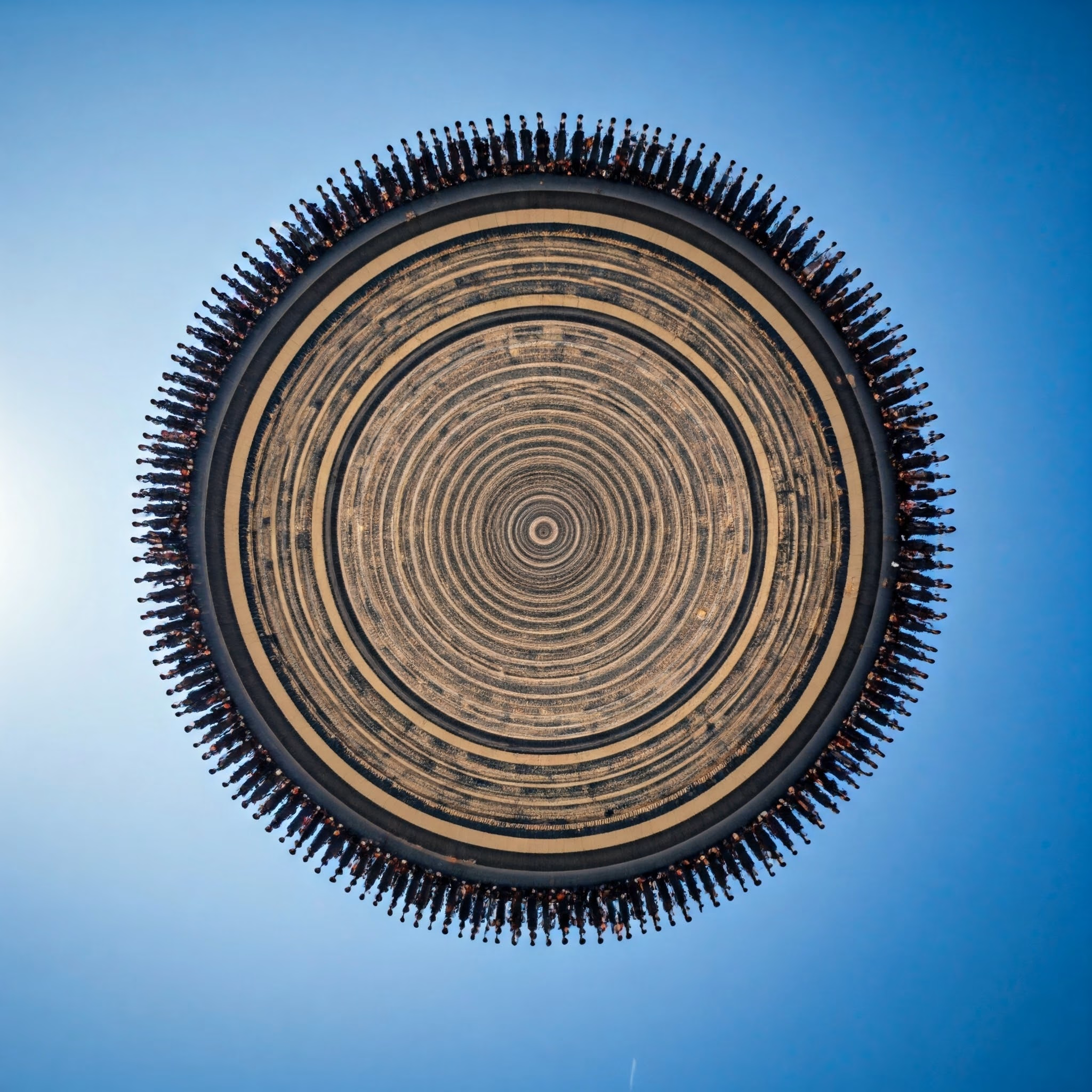
In today’s text, we observe that Jesus did not allow anyone to accompany Him except Peter, James, and John. This introduces us again to Jesus’ inner circle. Earlier, we learned that Jesus chose 12 disciples, and in other passages, we see that He sent out 72 disciples to preach the gospel. Through these accounts, we can visualize Jesus’ operational structure using concentric circles:
The Outermost Circle
Here, we find the nameless, faceless crowds who followed Jesus wherever He went. They heard His teachings, witnessed His miracles, and observed His interactions with others. A good example of this is found in chapter 3:
“And Jesus withdrew to the sea with His disciples; and a great multitude from Galilee followed; and from Judea.”
— Mark 3:7
The 70 Disciples
This group was sent out in pairs to preach the gospel, a precursor to the Great Commission given after Jesus’ resurrection:
“Now after this the Lord appointed seventy others, and sent them in pairs ahead of Him to every city and place where He Himself was going to come.”
— Luke 10:1
The 12 Disciples
Closer to Jesus were the 12 disciples, whom He personally chose and taught. They received special teachings and were witnesses to His resurrection:
“And when day came, He called His disciples to Him and chose twelve of them, whom He also named as apostles.”
— Luke 6:13“But the eleven disciples proceeded to Galilee, to the mountain which Jesus had designated. And when they saw Him, they worshiped Him; but some doubted.”
— Matthew 28:16-17
The 12 disciples, along with other followers, were given access to teachings and explanations that the crowds did not receive:
“And when He was alone, His followers, along with the twelve, began asking Him about the parables.”
— Mark 4:10
The Inner Circle: Peter, James, and John
Within the 12, there was an even smaller group—Peter, James, and John—referred to as Jesus’ inner circle. James and John, the brothers known as the Sons of Thunder, and Peter were witnesses to key events that others did not experience.
Key Events of the Inner Circle:
- The Raising of Jairus’ Daughter (Mark 5:37)
- The Transfiguration
“And six days later Jesus *brought with Him Peter and James and John his brother, and *led them up on a high mountain by themselves.”
— Matthew 17:1
- The Prayer in Gethsemane
“And He took with Him Peter and the two sons of Zebedee, and began to be grieved and distressed.”
— Matthew 26:37
In these instances, the inner circle witnessed a deeper side of Jesus. They received insights and teachings that were not shared with the other disciples.
Lessons from Jesus’ Leadership Structure
Jesus’ leadership model demonstrates strategic delegation. Instead of distributing His time equally among all followers, He divided His attention into smaller, focused groups. This structure allowed for deeper discipleship with His inner circle, who were then empowered to disciple others.
This model is not about creating an elite group; it is about equipping others to pass on the teachings. For example, Jesus charged Simon Peter with strengthening the brethren:
“Simon, Simon, behold, Satan has demanded to sift all of you like wheat. But I have prayed earnestly for you, that your faith may not fail; and you, once you have returned, strengthen your brothers.”
— Luke 22:31-32
Similarly, Jesus instructed Peter to tend to His flock:
“So when they had finished breakfast, Jesus said to Simon Peter, ‘Simon, son of John, do you love Me more than these?’ He said to Him, ‘Yes, Lord; You know that I love You.’ He said to him, ‘Tend My lambs.’”
— John 21:15
Application for Us Today
In following Jesus’ example, we must consider our circles of influence:
- Who is in our outer circle and inner circle?
- How are we investing in those in our inner circle to equip them for ministry?
Our goal is to empower those closest to us so they can disciple others, creating a ripple effect of spiritual growth and multiplication.
May we prayerfully design our circles of influence as Jesus did.


Leave a Reply