
But grow in the grace and knowledge of our Lord and Savior Jesus Christ. To Him be the glory, both now and to the day of eternity. Amen.
— 2 Peter 3:18
Here we see the final words Peter leaves with the scattered believers he has been writing to — and it is striking what he chooses to emphasise as he closes. The central theme of this final verse is growth. Peter expects believers to grow.
A Neglected Emphasis
This is something not often given the attention it deserves, even within the church. There is frequently a heavy emphasis on evangelism — on telling people the message of the gospel — and rightly so. But once a person has heard the gospel, received Christ, and joined a church, there is often very little intentional focus on what should happen next. Peter does not leave his readers there.
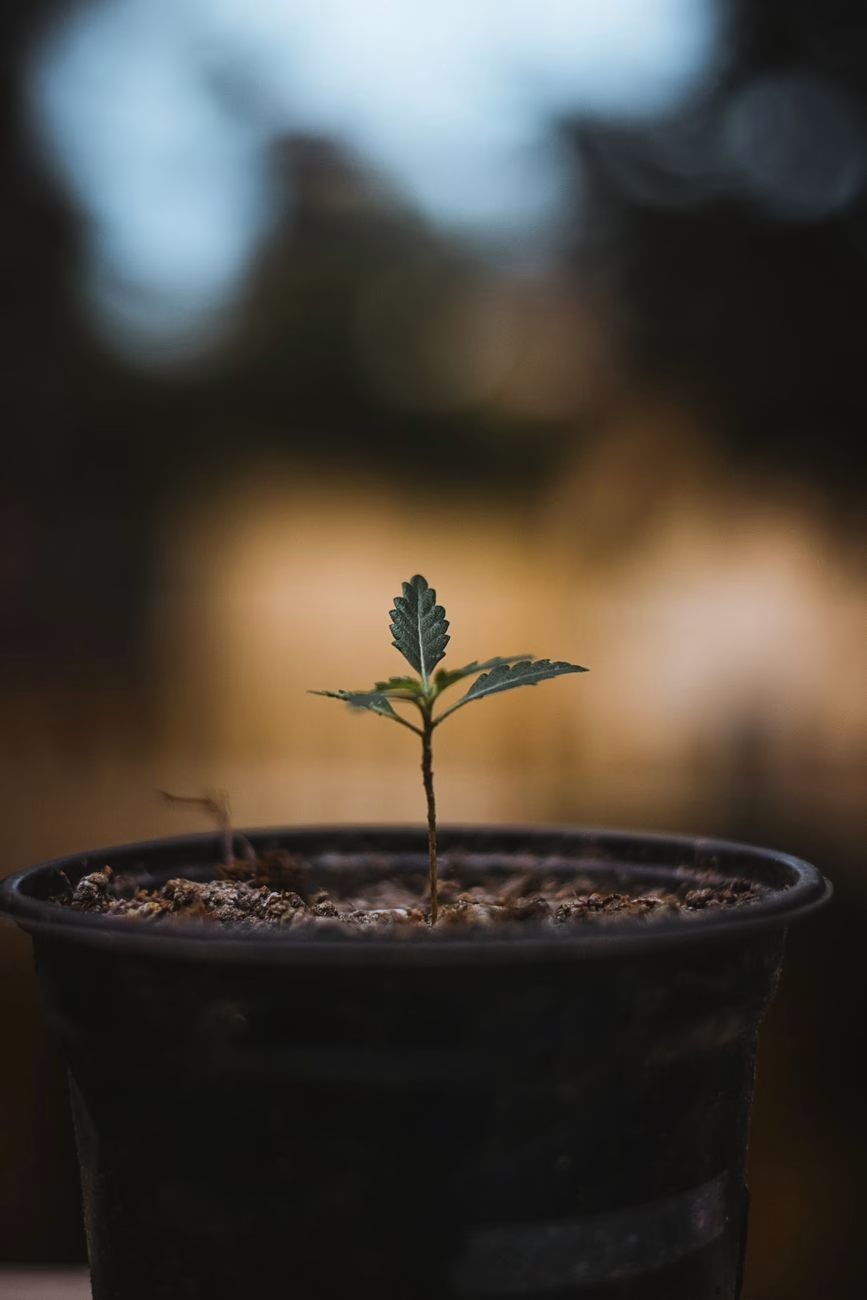
This expectation of growth is woven into the very language Scripture uses to describe conversion. In John 3, Jesus tells Nicodemus that he must be born again — and birth, by its very nature, implies growth. If a child is born and never grows beyond infancy, we recognise immediately that something is wrong. The expectation built into birth itself is that growth will follow.
The same is true spiritually. When a person is born again, growth is expected to follow. The author of Hebrews expresses real concern over a lack of this kind of growth:
For though by this time you ought to be teachers, you have need again for someone to teach you the elementary principles of the oracles of God, and you have come to need milk and not solid food. For everyone who partakes only of milk is not accustomed to the word of righteousness, for he is an infant. But solid food is for the mature, who because of practice have their senses trained to discern good and evil.
— Hebrews 5:12-14
Paul expresses a similar concern to the Ephesians, longing for them to reach maturity:
Until we all attain to the unity of the faith, and of the knowledge of the Son of God, to a mature man, to the measure of the stature which belongs to the fullness of Christ. As a result, we are no longer to be children, tossed here and there by waves and carried about by every wind of doctrine, by the trickery of men, by craftiness in deceitful scheming.
— Ephesians 4:13-14
Growing in Grace
Peter highlights two specific areas of growth — grace and knowledge. The first is growth in grace. This refers to the grace that comes from God, by which the believer is progressively transformed from one degree of glory to another, through the ongoing work of the Holy Spirit.
While this transformation is spiritual and not always visible to the eye, its fruit becomes evident over time. Peter himself describes these marks earlier in his letter:
Now for this very reason also, applying all diligence, in your faith supply moral excellence, and in your moral excellence, knowledge, and in your knowledge, self-control, and in your self-control, perseverance, and in your perseverance, godliness, and in your godliness, brotherly kindness, and in your brotherly kindness, love. For if these qualities are yours and are increasing, they render you neither useless nor unfruitful in the true knowledge of our Lord Jesus Christ.
— 2 Peter 1:5-8
These are the visible marks of grace — moral excellence, knowledge, self-control, perseverance, godliness, brotherly kindness, and love. Peter calls believers to be diligent in cultivating these qualities, fixing their eyes on Christ, walking by the Spirit, and being renewed daily through repentance and the putting away of sin.
Paul describes something very similar in his list of the fruit of the Spirit:
But the fruit of the Spirit is love, joy, peace, patience, kindness, goodness, faithfulness, gentleness, self-control; against such things there is no law.
— Galatians 5:22-23
Growing in Knowledge
The second area of growth Peter highlights is the knowledge of God. Every believer is called to put real effort into growing in their knowledge of who God is — and this growth happens primarily through faithful, careful, and consistent engagement with Scripture.
Paul reminds Timothy of this connection between growth and the Word of God:
And that from childhood you have known the sacred writings which are able to give you the wisdom that leads to salvation through faith which is in Christ Jesus.
— 2 Timothy 3:15
Peter, too, was deeply convinced of this. He had already written that it was the Word of God that brought about new birth in the first place:
For you have been born again not of seed which is perishable but imperishable, that is, through the living and enduring word of God.
— 1 Peter 1:23
And he calls believers to cultivate a genuine hunger for that Word, like the appetite of a newborn:
Like newborn babies, long for the pure milk of the word, so that by it you may grow in respect to salvation.
— 1 Peter 2:2
Growing Until Glory
This is the posture Peter calls every believer to — continual growth in grace and in the knowledge of God. May we be a people who is constantly growing in both, until that great day when we are reunited with our Father in glory.
Amen.

Leave a Reply