
Greetings, dear ones,
Today, let’s explore how God takes it upon Himself to gather His own and place them in a safe haven when those He entrusted with the task failed to do the job:
For thus says Lord Yahweh, “Behold, I Myself will seek My sheep and care for them.
— Ezekiel 34:11
At the beginning of this chapter, we see that the responsibility of taking care of the sheep was given to the shepherds of Israel.
“Son of man, prophesy against the shepherds of Israel. Prophesy and say to those shepherds, ‘Thus says Lord Yahweh, “Woe, shepherds of Israel who have been shepherding themselves! Should not the shepherds shepherd the flock?
— Ezekiel 34:2
The word that came to the prophet Ezekiel clearly states that the shepherds had failed. Instead of taking on the responsibility given to them by God to care for the sheep, they fed themselves.
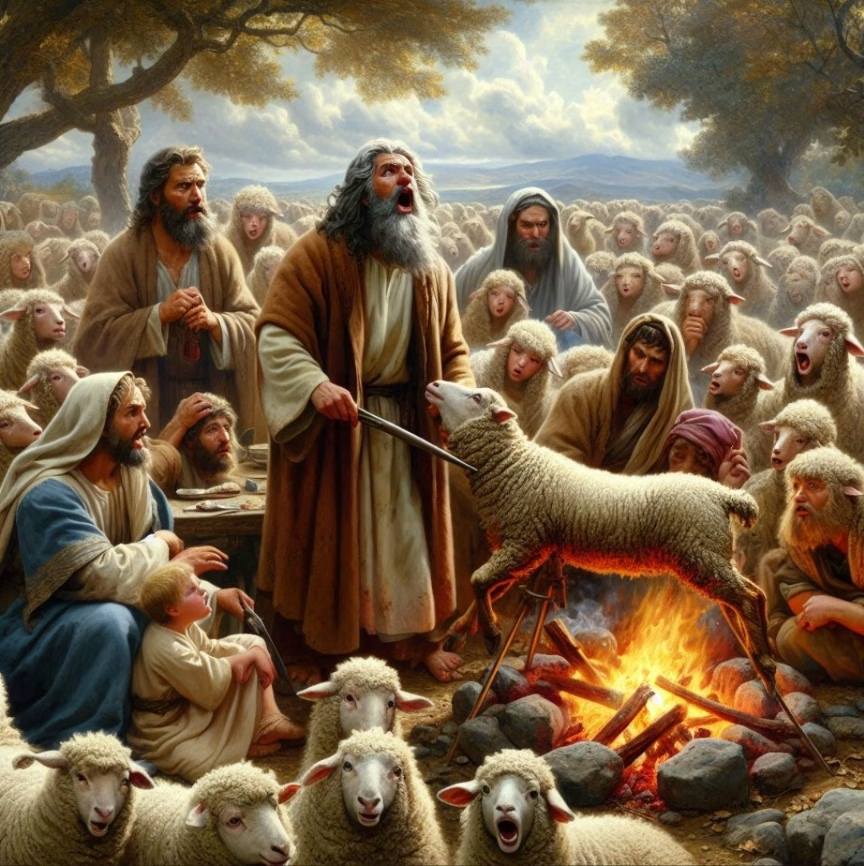
You eat the fat and clothe yourselves with the wool; you sacrifice the fat sheep without shepherding the flock.
— Ezekiel 34:3
Furthermore, they neglected their other responsibilities, such as seeking the stray sheep, feeding the sheep, and binding the injured.
My flock wandered through all the mountains and on every high hill; My flock was scattered over all the surface of the earth, and there was no one to seek or search for them.”’”
— Ezekiel 34:6
Because of this, God’s anger was kindled against the shepherds. He was displeased because their actions had consequences. The children of God were left defenseless against all kinds of enemies because the shepherds neglected their duty to protect the flock.
“As I live,” declares Lord Yahweh, “surely because My flock has become plunder, My flock has even become food for all the beasts of the field for lack of a shepherd, and My shepherds did not seek for My flock, but rather the shepherds shepherded themselves and did not shepherd My flock;
— Ezekiel 34:8
God says the sheep became food for the beasts and the flock became plunder. He attributes this to the lack of shepherds, indicating that their neglect led to the sheep facing these trials.
The disobedience of the shepherds toward the beloved ones of God, the children of Israel, brought God’s judgment upon them.
‘Thus says Lord Yahweh, “Behold, I am against the shepherds, and I will seek My flock from their hand and make them cease from shepherding the flock. So the shepherds will not shepherd themselves anymore, but I will deliver My flock from their mouth so that they will not be food for them.”’”
— Ezekiel 34:10
God’s judgment on the shepherds begins with a declaration that He is against them. This is never a good place to be. Moreover, part of the judgment involves taking away all the perks that the shepherds enjoyed. God says the shepherds will not shepherd themselves anymore. In other words, God removes the privileges of being a shepherd from these false shepherds.
Being a shepherd came with blessings. It was supposed to be a privilege to serve the Almighty God of the universe. The misuse of this authority led to the loss of these privileges.
The final piece of God’s judgment involves Him taking on the responsibility to look after His own sheep. In the verse we are looking at today, we see God saying that He Himself will seek the sheep and take care of them.
The rest of the prophecy describes how God undoes everything the false, incompetent shepherds had done.
I will bring them out from the peoples and gather them from the countries and bring them to their own land; and I will shepherd them on the mountains of Israel, by the streams, and in all the inhabited places of the land.
— Ezekiel 34:13
We see that God’s first step in untangling the shepherds’ wickedness is to gather the lost sheep. God says He will bring them from far countries to a secure and safe place.
Moreover, where the shepherds left the sheep hungry and focused only on feeding themselves, God takes a different route. Being a gracious God and the true shepherd, God then feeds His sheep with good pasture.
I will shepherd them in a good pasture, and their grazing ground will be on the mountain heights of Israel. There they will lie down on good grazing ground and be shepherded in rich pasture on the mountains of Israel.
— Ezekiel 34:14
Finally, we see God mercifully taking it upon Himself to seek the lost sheep, bind the injured, and care for the sheep. God’s care for His sheep is an ongoing process. He continuously seeks the lost, binds the injured, and feeds the sheep day after day.
“I will search for the lost, bring back the scattered, bind up the broken, and strengthen the sick; but the fat and the strong I will destroy. I will shepherd them with judgment.
— Ezekiel 34:16
There are two very important things to note from these passages:
1. The Danger of Irresponsible Shepherds
While the primary application of the shepherds’ role points to pastors, teachers, and elders in the church, it is also important to remember that, in His divine providence, God has placed sheep in our lives whom we affect through our interactions.
God has given us certain responsibilities to represent Him. Just like the shepherds, we are providentially placed in our lives to minister to certain people that God puts in our path. We must be very careful and always remember that we are dealing with God’s sheep.
Doing nothing from selfish ambition or vain glory, but with humility of mind regarding one another as more important than yourselves, not merely looking out for your own personal interests, but also for the interests of others.
— Philippians 2:3-4
We should be careful not to shepherd only ourselves and feed ourselves. We must understand that God has providentially placed His sheep in our lives, and we are meant to minister to them. This was the task Christ gave to Peter:
So when they had finished breakfast, Jesus said to Simon Peter, “Simon, son of John, do you love Me more than these?” He said to Him, “Yes, Lord; You know that I love You.” He said to him, “Tend My lambs.” He said to him again a second time, “Simon, son of John, do you love Me?” He said to Him, “Yes, Lord; You know that I love You.” He said to him, “Shepherd My sheep.” He said to him the third time, “Simon, son of John, do you love Me?” Peter was grieved because He said to him the third time, “Do you love Me?” And he said to Him, “Lord, You know all things; You know that I love You.” Jesus said to him, “Tend My sheep.
— John 21:15-17
It is also important to remember that we will have to account for failing to perform this responsibility.
“As for you, My flock, thus says Lord Yahweh, ‘Behold, I will judge between one sheep and another, between the rams and the male goats.
— Ezekiel 34:17
2. The Loving Care of a Gracious God
This is very good news to the sheep. As we are sheep belonging to a loving God, He will take it upon Himself to ensure that we are taken care of. Whenever we wander astray, God will bring us back, and whenever we are injured, God Himself will bind our wounds.
This is comforting news to those who have placed their faith in God. It is a reminder that we serve a loving God who will work all things for good, in accordance with His great will.
May we never come to a place of despair or give up on life. We should always remember that we serve a God who will take it upon Himself to ensure that we are safe in His arms. Regardless of the trials and tribulations we go through in this life, may we always remember that we serve a God who will always come through for us to accomplish His divine will.
Let’s remember this:
- Let us be mindful of the responsibilities given to us by God, especially those that involve shepherding others.
- Let us be careful not to misuse the privileges given to us by God to shepherd His flock.
- Let us always lean on God for everything. We can’t put our faith merely in the shepherd, but be reminded that even when the shepherd fails to do the task, God will do it Himself.
May the peace of God be with you,
Paul
Leave a Reply